Clean water is one of the world’s most valuable resources, yet it is becoming increasingly difficult to maintain. Rapid industrialization, urban growth, and environmental pollution have significantly increased the burden on water treatment facilities worldwide. Whether it is drinking water, process water, or industrial wastewater, effective treatment has become essential for protecting public health and preserving natural ecosystems.
Today, industries are not only looking for effective treatment methods but also searching for sustainable alternatives that reduce environmental impact. This shift has increased interest in natural polymers and biodegradable additives that can support various stages of water processing.
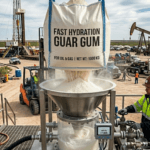
One such material is guar gum. While traditionally known for its applications in food, pharmaceuticals, textiles, oil drilling, and paper manufacturing, the use of guar gum in water treatmentis gaining attention as industries explore more sustainable solutions for water clarification and wastewater management.
As companies seek environmentally responsible alternatives to conventional water treatment chemicals, guar gum offers an interesting option due to its natural origin, biodegradability, and unique rheological properties.
Water contamination remains a major challenge across the globe. Industrial discharge, agricultural runoff, suspended solids, oils, heavy metals, and organic matter can all affect water quality.
To address these issues, treatment facilities employ a combination of physical, chemical, and biological processes. The objective is simple: remove contaminants and make water safe for its intended use.
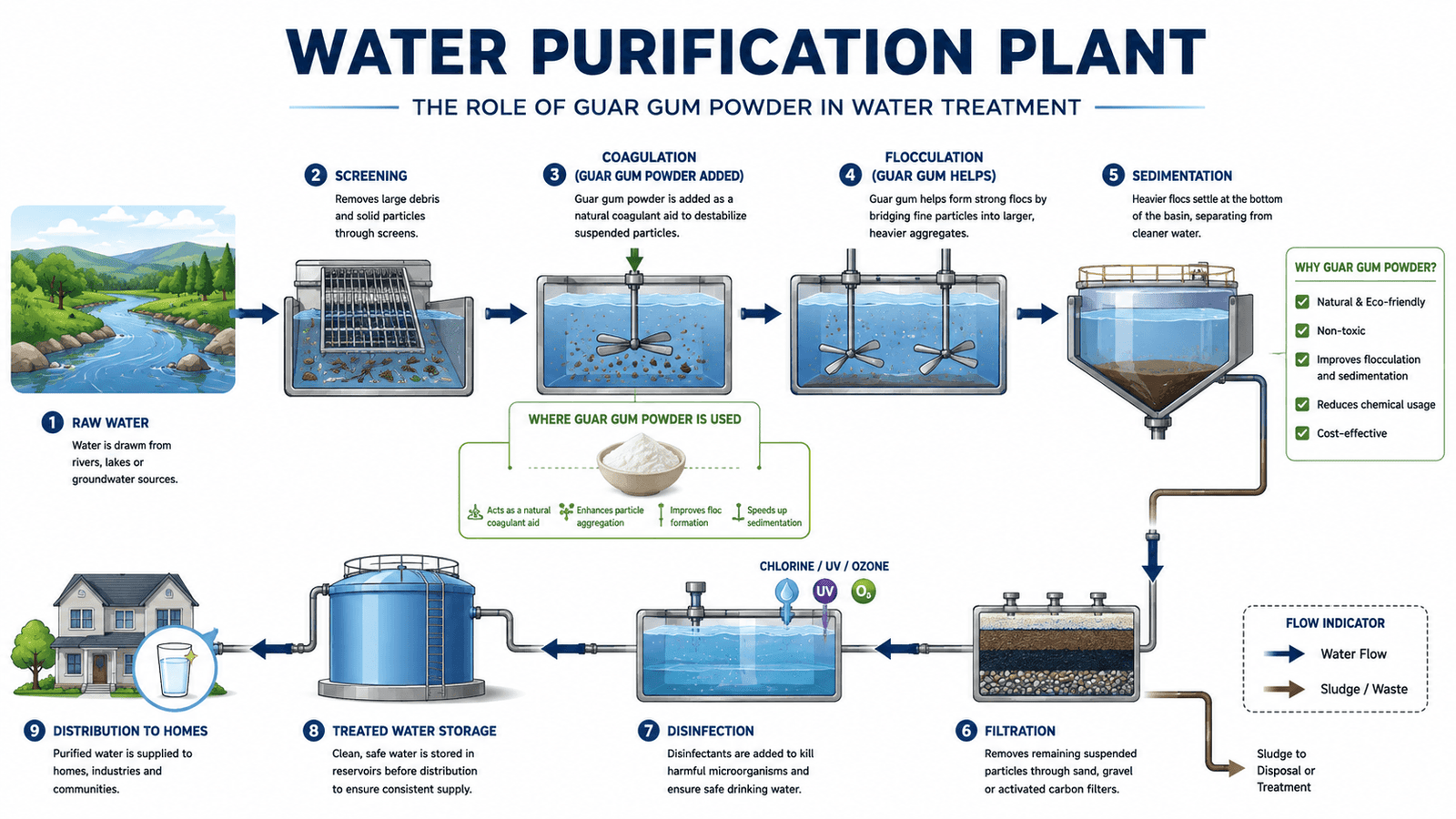
A typical water treatment process step by step includes: Screening and preliminary treatment, Coagulation, Flocculation, Sedimentation, Filtration, Disinfection and Distribution or discharge. Each stage plays an important role in ensuring that contaminants are removed efficiently. Let’s know what these are briefly and where guar gum is used primarily —
1. Screening and Preliminary Treatment
This is the first stage of the treatment process. Water entering a treatment plant often contains large debris such as leaves, sticks, plastic materials, paper, and other solid waste. Special screens and filters are used to remove these unwanted materials before the water moves to the next stage.
Think of it as the first line of defense that protects treatment equipment from damage and prevents blockages further down the system.
1. Coagulation:
Many contaminants in water are extremely small and cannot be removed by simple screening. During coagulation, specific water treatment chemicals called coagulants are added to the water. These chemicals neutralize the electrical charges of tiny suspended particles, which makes them less stable and easier to group together.
In simple terms, coagulation prepares the tiny impurities to join together so they can be removed more effectively.
2. Flocculation:
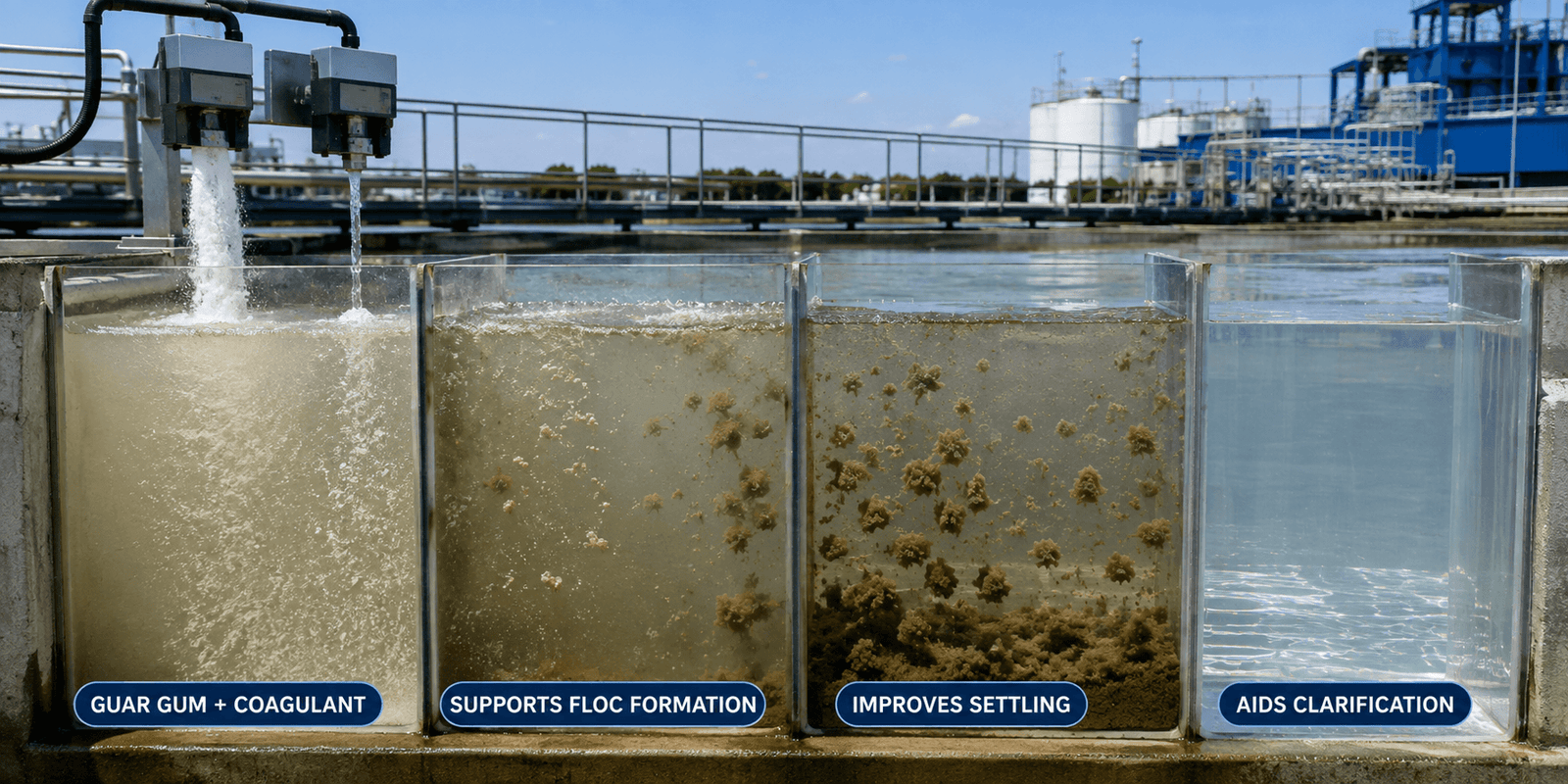
After coagulation comes the flocculation process. The water is gently mixed to encourage the small particles to collide and combine into larger, heavier clusters known as “flocs.”
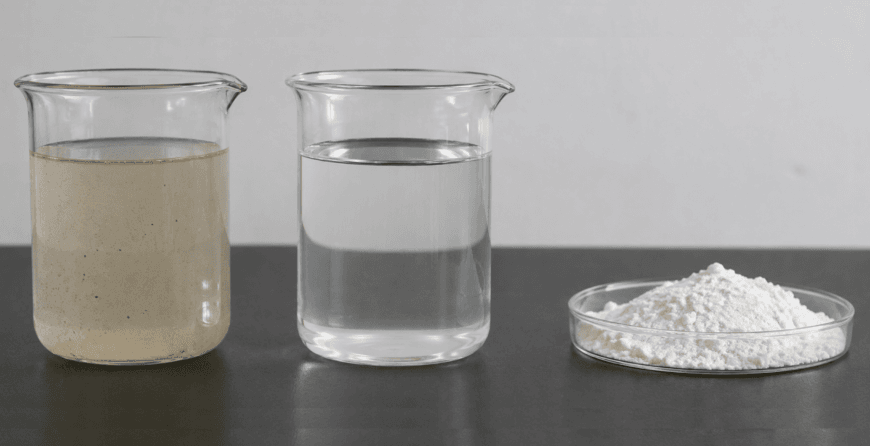
This stage is where natural polymers and certain additives can play an important role. Guar gum for water treatment is often used as a natural flocculant aid. It helps tiny suspended particles stick together and form larger flocs, making them easier to remove in the next stages of the treatment process.
Imagine tiny dust particles in water joining together to form larger clusters that can settle more easily.
3. Sedimentation:
Once larger flocs are formed, the water enters sedimentation tanks. Because the flocs are now heavier, they gradually settle to the bottom under the force of gravity.
When guar gum helps create larger and heavier flocs during flocculation, those flocs tend to settle faster during sedimentation. This can improve the removal of suspended solids and support a more efficient water clarification process.
This stage is a key part of the water clarification process, helping remove a significant amount of suspended solids and contributing to effective turbidity removal.
The settled material collected at the bottom eventually becomes sludge and is sent for further treatment.
4. Filtration:
Even after sedimentation, some fine particles and impurities may remain in the water. During filtration, water passes through layers of sand, gravel, activated carbon, or specialized filter media.
These filters capture remaining contaminants, which further produces much cleaner water before the final treatment stages.
Filtration is one of the most important steps in the overall water purification process because it helps improve water clarity and quality.
5. Disinfection:
At this stage, most physical impurities have already been removed. However, harmful microorganisms such as bacteria, viruses, and parasites may still be present.
To eliminate these pathogens, treatment facilities use disinfection methods such as:
• Chlorination
• Ultraviolet (UV) treatment
• Ozonation
Disinfection ensures the water is safe for human use and helps prevent waterborne diseases.
6. Distribution or Discharge:
The final step depends on the purpose of the treated water.
• If the water is intended for public consumption, it is distributed through pipelines to homes, businesses, and communities.
• In industrial wastewater treatment facilities, treated water may be reused in manufacturing processes or safely discharged into rivers, lakes, or other approved water bodies according to environmental regulations.
This final stage ensures that treated water can be safely utilized while supporting responsible wastewater management practices. The increasing complexity of water contamination has also led to the growth of the water treatment chemicals industry, which continuously develops products designed to improve treatment performance and water quality.
Putting It All Together
To summarize, the water treatment process step by step involves removing large debris, grouping tiny impurities together, allowing them to settle, filtering the water, disinfecting it, and finally distributing or safely discharging it. Each stage works together to transform contaminated water into cleaner, safer water suitable for its intended use.
Benefits of Guar Gum in Water Treatment:
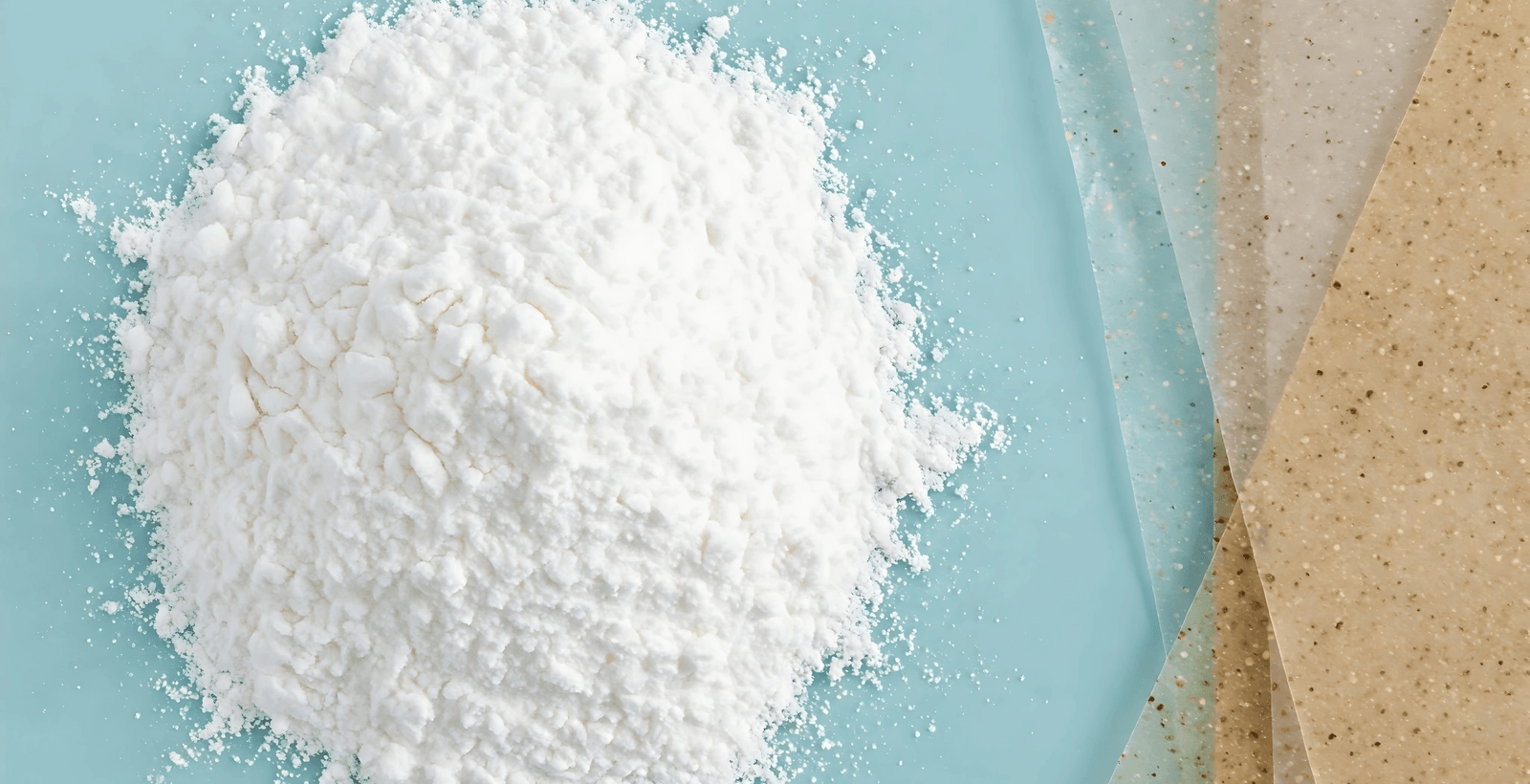
Guar gum is a natural polysaccharide extracted from the endosperm of guar beans (Cyamopsis tetragonoloba). It is widely recognized for its exceptional ability to absorb water and create highly viscous solutions even at low concentrations.
Because of these characteristics, guar gum has become a valuable ingredient in numerous industries.
Some of its most common applications include:
• Food processing
• Textile printing
• Pharmaceutical formulations
• Paper manufacturing
• Oil and gas drilling
• Animal feed
• Cosmetics and Personal Care
In recent years, researchers and industrial operators have also explored guar gum for water treatment applications because of its ability to interact with suspended particles and influence fluid behavior.
Guar gum can assist the water treatment process by helping suspended particles come together during flocculation. The larger flocs formed are easier to settle and remove, which can contribute to improved water clarity and overall treatment efficiency. As a biodegradable and naturally derived material, guar gum is also gaining attention as a more sustainable option for certain water treatment applications.
The Growing Need for Sustainable Water Treatment Solutions
For decades, industries have relied heavily on synthetic wastewater treatment chemicals and treatment additives. While many of these products perform effectively, growing environmental concerns have encouraged organizations to investigate greener alternatives.
Sustainability is now a major priority across the water treatment chemicals industry.
Companies are increasingly interested in:
• Reducing chemical consumption
• Improving biodegradability
• Lowering environmental impact
• Supporting circular economy initiatives
• Enhancing water reuse programs
This shift has created opportunities for natural materials that can contribute to eco-friendly water treatment practices.
How Guar Gum Supports the Water Clarification Process:
One of the most important objectives of water treatment is removing suspended particles that create turbidity.
The water clarification process focuses on separating these particles from water so that cleaner water can move to the next treatment stage.
In certain applications, guar gum can function as a natural polymer that helps improve particle aggregation. When fine particles combine into larger masses, they become easier to settle or separate.
This can support:
• Improved settling efficiency
• Better solid-liquid separation
• Enhanced turbidity removal
• More effective downstream filtration
Because of these characteristics, guar gum water clarification applications continue to attract interest from industries seeking bio-based treatment alternatives.
How Guar Gum Supports the Water Clarification Process:
One of the most important objectives of water treatment is removing suspended particles that create turbidity.
The water clarification process focuses on separating these particles from water so that cleaner water can move to the next treatment stage.
In certain applications, guar gum can function as a natural polymer that helps improve particle aggregation. When fine particles combine into larger masses, they become easier to settle or separate.
This can support:
• Improved settling efficiency
• Better solid-liquid separation
• Enhanced turbidity removal
• More effective downstream filtration
Because of these characteristics, guar gum water clarification applications continue to attract interest from industries seeking bio-based treatment alternatives.
Guar Gum as a Water Treatment Clarification Polymer:
Polymers are commonly used throughout the treatment sector to improve particle removal and enhance separation processes.
A water treatment polymer works by helping small suspended particles combine into larger structures that can be removed more easily.
Traditionally, many synthetic polymers have been used for this purpose. However, environmental concerns have encouraged researchers to investigate renewable alternatives.
Guar gum offers several advantages as a natural polymer:
• Plant-based origin
• Renewable raw material
• Biodegradable properties
• High water-binding capacity
• Excellent thickening performance
These qualities make it one of the more promising natural water treatment additives being explored for specialized treatment applications.
The Role of Guar Gum in Flocculation Process:
The flocculation process is one of the most critical stages of water treatment.
After coagulation destabilizes suspended particles, flocculation encourages those particles to come together and form larger flocs.
Larger flocs are easier to remove through settling or filtration.
Because guar gum can increase viscosity and improve particle interaction under certain conditions, it may assist floc formation in selected industrial systems.
Benefits may include:
• Improved particle aggregation
• Enhanced sedimentation
• Reduced suspended solids
• Better treatment efficiency
These advantages explain why interest in guar gum for water treatment continues to grow among industries looking for sustainable alternatives.
Applications of Industrial Wastewater Treatement:
Water treatment is not limited to drinking water systems. Many industries generate wastewater that requires careful treatment before reuse or discharge.
Examples include:
• Textile manufacturing
• Food processing
• Mining operations
• Chemical manufacturing
• Pulp and paper production
In industrial wastewater treatment, operators must remove suspended solids, organic matter, oils, and other contaminants.
The challenge is even greater in large-scale wastewater treatment industrial facilities where treatment volumes are substantial.
Natural polymers like guar gum may support:
• Solid-liquid separation
• Sedimentation processes
• Sludge conditioning
• Clarification systems
As sustainability goals become more important, many organizations involved in industrial wastewater treatment are evaluating renewable materials that complement existing treatment programs.
Guar Gum and Wastewater Management:
Effective wastewater management is essential for both environmental protection and resource conservation.
Poorly managed wastewater can contaminate rivers, lakes, groundwater, and agricultural land.
Modern wastewater strategies focus on:
• Water reuse
• Pollution prevention
• Resource recovery
• Sustainable treatment practices
Natural polymers can contribute to these goals by helping facilities reduce dependence on certain synthetic additives.
As a result, guar gum is increasingly being considered as part of broader wastewater treatment solutions aimed at improving environmental performance.
Supporting Sludge Treatment Operations:
One often-overlooked aspect of water treatment is sludge handling.
Every treatment facility generates sludge as contaminants are removed from water.
Managing this sludge efficiently is critical because disposal costs can be significant.
In some applications, guar gum may assist sludge treatment processes by improving sludge consistency and supporting dewatering operations.
Potential benefits include:
• Improved sludge handling
• Better dewatering performance
• Reduced transportation costs
• Enhanced operational efficiency
These advantages make natural polymers attractive to facilities focused on long-term sustainability.
Water Purification Natural Methods and Sustainable Trends:
Consumers and industries alike are showing increasing interest in water purification natural methods.
This trend reflects a broader desire to reduce environmental impact while maintaining treatment effectiveness.
Examples include:
• Natural filtration media
• Bio-based adsorbents
• Constructed wetlands
• Plant-based treatment additives
• Renewable polymers like guar gum powder
The same sustainability movement has increased demand for products such as the eco friendly water filter, eco friendly water filtration system, and eco-friendly water purifier technologies.
Although large-scale treatment systems often require advanced engineering, natural materials continue to play an increasingly important role.
Water Treatment Chemicals vs. Natural Alternatives:
Many facility operators search for the top 10 water treatment chemicals when evaluating treatment programs.
Common products include:
• Alum
• Ferric chloride
• Polyaluminum chloride
• Chlorine
• Sodium hypochlorite
• Activated carbon
• Lime
• Caustic soda
• Polymer flocculants
• Corrosion inhibitors
These products remain essential for modern treatment systems.
However, the growing interest in sustainability has encouraged industries to investigate complementary natural materials such as guar gum.
Rather than replacing all conventional water treatment chemicals, guar gum may serve as a supportive component within specific treatment applications.
Understanding the Water Purification Process:
Every treatment system relies on a carefully designed water purification process to remove contaminants and improve water quality.
For those learning about treatment systems, the commonly recognized 5 methods of water purification include:
1. Filtration
2. Sedimentation
3. Distillation
4. Chlorination
5. Ultraviolet treatment
Each method targets different types of contaminants.
Many modern facilities combine several methods to achieve the highest possible water quality while meeting regulatory requirements.
Opportunities for Water Treatment Companies:
The global market for treatment technologies continues to expand rapidly.
Every major water treatment chemicals company is investing in research, sustainability initiatives, and innovative treatment solutions.
The future of the water treatment chemicals industry is expected to focus on:
• Resource efficiency
• Water recycling
• Sustainable chemistry
• Green treatment technologies
• Renewable materials
Natural polymers like guar gum align closely with these priorities.
As environmental regulations become stricter and customers demand greener products, bio-based materials are expected to receive increasing attention.
Future Outlook for Guar Gum in Water Treatment:
The future of guar gum in water treatment looks promising as industries seek solutions that balance performance and sustainability.
Research continues to explore how guar gum derivatives and modified guar products can support:
• Water clarification
• Solid-liquid separation
• Sludge management
• Industrial wastewater treatment
• Sustainable treatment programs
While it may not replace traditional treatment systems, guar gum offers an environmentally responsible option that complements modern treatment technologies.
Conclusion:
The demand for clean water continues to rise, making innovation within the water treatment chemicals industry more important than ever. As organizations search for sustainable alternatives, guar gum in water treatment is emerging as a promising natural polymer that can support the water clarification process, improve turbidity removal, assist the flocculation process, and contribute to effective wastewater management.
From industrial wastewater treatment facilities to broader wastewater treatment solutions, guar gum demonstrates how renewable materials can help create more sustainable water systems. As the world moves toward greener technologies and eco-friendly water treatment practices, the role of natural polymers such as guar gum is likely to continue growing in importance.
1. What is guar gum in water treatment?
Guar gum in water treatment refers to the use of guar gum as a natural polymer that can support water clarification and wastewater treatment processes.
2. How does guar gum for water treatment work?
Guar gum for water treatment can help suspended particles bind together, making them easier to remove during the flocculation and sedimentation stages.
3. Is guar gum a water treatment chemical?
Guar gum is a natural, plant-based additive that may complement certain water treatment chemicals in specific applications.
4. Can guar gum help with turbidity removal?
Yes, guar gum may support turbidity removal by helping fine particles form larger flocs that settle more efficiently.
5. Is guar gum used in industrial wastewater treatment?
Guar gum can be explored for use in industrial wastewater treatment where improved solid-liquid separation and water clarification are required.
6. Why is guar gum considered an eco-friendly water treatment solution?
Since it is derived from guar beans and is biodegradable, guar gum is often viewed as a sustainable option for eco-friendly water treatment initiatives.
7. What role does guar gum play in the flocculation process?
During the flocculation process, guar gum may assist in bringing smaller particles together to form larger, removable flocs.
8. Can guar gum support wastewater management efforts?
Yes, by aiding clarification and sludge handling in certain systems, guar gum can contribute to more effective wastewater management practices.
9. Is guar gum a water treatment polymer?
Yes, guar gum is a natural water treatment polymer known for its thickening, binding, and suspension-supporting properties.
10. What are the benefits of using guar gum in water treatment?
The main benefits of guar gum in water treatment include its natural origin, biodegradability, potential clarification support, and compatibility with sustainable treatment approaches.