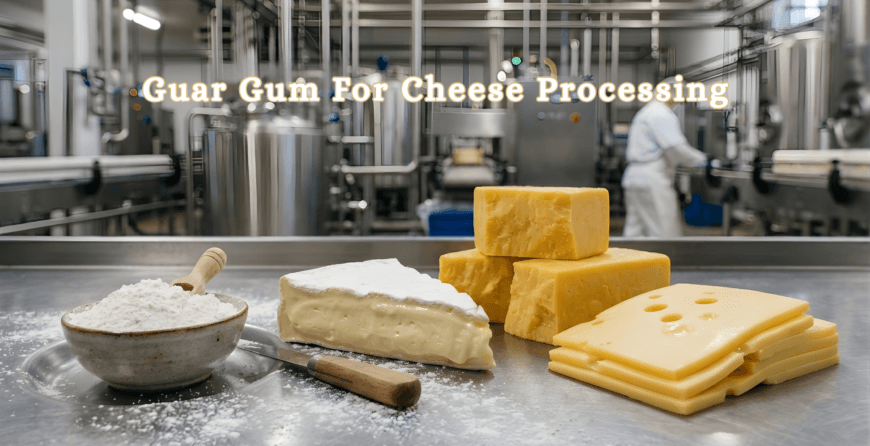
The cheese industry is constantly looking for ways to improve product quality, consistency, and profitability. Whether it is soft cheese, processed cheese, cream cheese, or specialty cheese varieties, manufacturers need ingredients that can help maintain texture, improve stability, and reduce production losses. One ingredient that has gained significant attention in recent years is Guar Gum in Cheese.
Derived from guar beans, guar gum is a natural hydrocolloid widely used in the food industry. It acts as a thickener, stabilizer, and water-binding agent, making it particularly valuable in dairy applications. Today, many cheese manufacturers use Guar Gum in Cheese formulations to improve texture, control moisture, and enhance product performance throughout storage and distribution.
In this blog, we will explore nine proven benefits of Guar Gum in Cheese production and explain why it has become a preferred ingredient for modern cheese manufacturers.
Guar gum is a natural polysaccharide extracted from guar beans. It is widely used as a food additive because of its exceptional ability to absorb water and create viscosity even at low concentrations.
Guar Gum in dairy products, specially guar gum for cheese applications helps improve consistency, texture, and stability while supporting efficient manufacturing processes. Due to its versatility, it is commonly used in processed cheese, cream cheese, cheese spreads, and various soft cheese products.
As a natural guar gum stabilizer, it provides functional benefits without significantly affecting flavor or aroma.
Why is Guar Gum Used In Cheese?
Cheese manufacturers face several challenges, including:
1. Moisture loss during storage
2. Inconsistent texture
3. Product separation
4. Reduced yield
5. Difficulty maintaining quality during transportation
Using Guar Gum in Cheese helps address these challenges effectively. Because guar gum binds water efficiently, it contributes to a smoother texture, improved stability, and better overall product quality.
Let’s look at the nine key benefits.
1. Improves Cheese Texture:
One of the most important advantages of Guar Gum in Cheese is its ability to improve texture.
Consumers expect cheese products to have a smooth, creamy, and consistent mouthfeel. Without proper stabilization, cheese can become grainy, dry, or uneven.
As a natural guar gum thickener, guar gum helps create a uniform structure throughout the product. It enhances creaminess and provides a more appealing eating experience.This benefit is especially important for cream cheese, processed cheese, and cheese spreads.
2. Enhances Moisture Retention:
Moisture retention plays a critical role in cheese quality.
Water loss can negatively affect texture, weight, and appearance. By using Guar Gum in Cheese, manufacturers can improve water-holding capacity and maintain product freshness.
The ability of guar gum to bind water helps prevent excessive drying and shrinkage during storage. This is particularly beneficial for products requiring extended shelf life.
For this reason, many dairy processors prefer guar gum for cheese processing operations where moisture control is essential.
3. Increases Product Yield:
Higher yield means greater profitability.
One of the major reasons manufacturers use Guar Gum in Cheese is its ability to improve moisture retention, which directly contributes to higher finished-product yield.
Since guar gum helps retain water within the cheese matrix, less product weight is lost during production and storage.
This allows manufacturers to maximize output while maintaining product quality, making guar gum in cheese processing a cost-effective solution.
4. Improves Stability During Storage:
Storage stability is critical for commercial cheese production.
Temperature fluctuations, transportation conditions, and extended storage periods can affect cheese quality.
Using Guar Gum in Cheese helps maintain product structure throughout the supply chain. As an effective guar gum stabilizer, it minimizes changes in texture and consistency over time.
This ensures that consumers receive the same quality product regardless of when it is purchased.
5. Reduces Syneresis:
Syneresis refers to the separation of liquid from the cheese structure.
This problem is particularly common in soft and processed cheese products. Excessive whey separation can negatively impact product appearance and consumer acceptance.
By incorporating Guar Gum in Cheese, manufacturers can significantly reduce syneresis.
The water-binding properties of guar gum help maintain a stable structure and reduce liquid separation during storage.
This is one reason why guar gum for soft cheese applications is becoming increasingly popular worldwide.
6. Improves Spreadability:
Consumers often prefer cheese products that are easy to spread and use.
Cream cheese, cheese dips, and cheese spreads require a smooth and uniform consistency. Guar Gum in Cheese helps achieve the desired spreadability without compromising product stability.
As a functional guar gum thickener, it contributes to a creamy texture that improves consumer satisfaction.
This benefit is particularly valuable in premium dairy products where texture significantly influences purchasing decisions.
7. Supports Consistent Cheese Quality:
Consistency is essential in commercial food manufacturing.
Customers expect every batch of cheese to have the same appearance, texture, and performance. Variations can damage brand reputation and customer trust.
By using Guar Gum in Cheese, manufacturers can improve batch-to-batch consistency.
Its ability to stabilize moisture and texture helps maintain uniform quality across production runs.
This makes guar gum for cheese processing an important ingredient for large-scale dairy operations.
8. Helps Extend Shelf Life:
Shelf life is a major concern for cheese manufacturers and distributors.
Products that maintain their quality for longer periods are easier to transport and sell across broader markets.
Guar Gum in Cheese helps preserve moisture and maintain texture, reducing quality deterioration over time.
While guar gum is not a preservative, its stabilizing properties contribute to improved product performance during storage.
As a result, many producers incorporate guar gum in cheese making to support shelf-life goals.
9. Improves Process Efficiency:
Efficient processing helps reduce costs and improve productivity.
Modern dairy facilities require ingredients that perform reliably under different manufacturing conditions.
Using Guar Gum in Cheese helps improve process control by providing predictable viscosity and stabilization.
Manufacturers often choose guar gum for cheese formulations because they simplify production and help achieve consistent results.
This makes guar gum a valuable ingredient in both small-scale and industrial cheese production.
Applications of Guar Gum in Different Cheese Types:
1. Cream Cheese:
Cream cheese requires a smooth, rich texture. Guar Gum in Cheese formulations help improve creaminess, moisture retention, and spreadability. 2. Processed Cheese:
Processed cheese products benefit from improved stability and texture when guar gum for cheese processing is used appropriately. 3. Cheese Spreads:
Cheese spreads require excellent viscosity and consistency. As a guar gum thickener, guar gum helps create a desirable texture. 4. Soft Cheese:
Many manufacturers use guar gum for soft cheese products because it helps reduce syneresis and maintain moisture content. 5. Specialty Cheese Products:
Specialty dairy products often require customized texture and stability characteristics. Guar Gum in Cheese applications help manufacturers meet these specific requirements.
How Guar Gum Works in Cheese Making:
Understanding how guar gum in cheese making works can help manufacturers optimize formulations.
Guar gum hydrates rapidly when mixed with water. Once hydrated, it forms a viscous solution that binds moisture throughout the cheese matrix.
1. This improves:
2. Water retention
3. Texture consistency
4. Product stability
5. Yield
6. Processing performance
Because of these functional properties, Guar Gum in Cheese applications continue to grow across the dairy industry.
Choosing the Right Guar Gum for Cheese Processing:
Not all guar gum grades are identical.
When selecting guar gum for cheese processing, manufacturers should consider:
1. Viscosity requirements
2. Particle size
3. Purity standards
4. Food safety certifications
5. Application type
6. Processing conditions
Working with a reliable supplier ensures consistent product quality and performance.
Food-grade guar gum should meet all applicable quality and regulatory standards to ensure safe use in dairy applications.
Future Trends in Cheese Manufacturing:
Consumer demand for high-quality dairy products continues to increase globally.
Manufacturers are focusing on ingredients that can improve texture, stability, and production efficiency while supporting clean-label initiatives.
As a natural guar gum stabilizer, guar gum aligns well with these objectives. Its versatility and effectiveness make it a valuable ingredient for modern dairy processing.
The growing use of Guar Gum in Cheese reflects the industry’s need for reliable solutions that improve both product quality and manufacturing performance.
Conclusion:
The use of Guar Gum in Cheese offers numerous advantages for dairy manufacturers. From improving texture and moisture retention to increasing yield and enhancing storage stability, guar gum provides practical benefits throughout the production process.
Whether used as a guar gum stabilizer, a guar gum thickener, or as part of advanced guar gum for cheese processing formulations, this versatile ingredient helps manufacturers achieve consistent, high-quality results.
As consumer expectations continue to rise, the role of Guar Gum in Cheese is expected to become even more important. Manufacturers seeking better texture, improved yield, enhanced stability, and efficient processing can benefit significantly from incorporating high-quality food-grade guar gum into their cheese products.
FAQs:
1. What does guar gum in cheese refer to?
Guar Gum in Cheese refers to the use of food-grade guar gum as a natural stabilizer and thickener to improve texture, moisture retention, consistency, and overall product quality.
2. Why is guar gum used in cheese production?
Guar gum is used to improve texture, reduce moisture loss, enhance stability, increase yield, and prevent whey separation during cheese manufacturing and storage.
3. Is guar gum safe for use in cheese?
Yes, food-grade guar gum is widely approved for use in dairy products and is considered safe when used according to food regulations and recommended levels.
4. How does guar gum improve cheese texture?
As a natural hydrocolloid, guar gum binds water and creates a smoother, creamier texture, helping cheese maintain a consistent mouthfeel.
5. Can guar gum increase cheese yield?
Yes, guar gum helps retain moisture within the cheese matrix, which can improve final product yield and reduce production losses.
6. What types of cheese commonly use guar gum?
Guar gum is commonly used in processed cheese, cream cheese, cheese spreads, soft cheese, and other dairy-based products requiring improved stability and texture.
7. Is guar gum for soft cheese applications suitable?
Yes, guar gum for soft cheese is widely used because it helps maintain moisture, improve creaminess, and reduce syneresis (liquid separation).
8. How does guar gum in cheese processing helps?
Guar gum for cheese processing improves viscosity control, moisture retention, product consistency, and manufacturing efficiency, making production more reliable.
9. What is the difference between guar gum and other cheese stabilizers?
Guar gum offers excellent water-binding properties, high viscosity at low concentrations, and cost-effective performance compared to many other stabilizers used in cheese production.
10. Can guar gum help extend the shelf life of cheese?
While guar gum is not a preservative, it helps maintain moisture and texture during storage, which contributes to better product quality and stability over time.