The oil and gas industry is always looking for better ways to recover oil from underground reservoirs. As oil fields mature, extracting the remaining oil becomes more challenging. Traditional recovery methods may leave a significant amount of oil trapped inside the reservoir. This is where Enhanced Oil Recovery (EOR) becomes important.
One material that has attracted interest in this area is guar gum. Known for its excellent thickening and water-binding properties, guar gum has several applications in the oil and gas industry. Researchers have also studied its potential to improve oil recovery through polymer flooding. Guar Gum in EOR is an interesting topic for oilfield chemical suppliers, petroleum engineers, and companies looking for alternative materials for oil recovery operations. Understanding how guar gum works, its possible benefits, and its limitations can help industry professionals make better decisions.
In this blog, we will explore the role of guar gum in enhanced oil recovery, how it influences fluid movement, and why product quality matters in oilfield applications.
Enhanced Oil Recovery, commonly known as EOR, refers to techniques used to extract additional oil from underground reservoirs after conventional recovery methods become less effective.
Oil recovery generally takes place in three stages.
1. Primary Oil Recovery (Natural Flow):
During primary recovery, natural pressure inside the reservoir pushes oil towards the production well. In some cases, pumps are used to bring the oil to the surface. However, this method cannot recover all the oil present in the reservoir. This only gets about 5% to 15% of the oil out.
2. Secondary Oil Recovery (Water/Gas Flooding):
Secondary recovery usually involves injecting water or gas into the reservoir to maintain pressure and move oil towards production wells. Water injection is one of the most common methods used during this stage. This recovers another 20% to 40% of the oil.
3. Tertiary Recovery / EOR (Changing the Oil’s Properties):
After the first two stages, up to 60% of the oil is still trapped tight inside the rock pores. EOR techniques are used to improve oil production beyond what primary and secondary methods can achieve. These techniques may involve injecting chemicals, gases, or other materials to improve the movement of oil through the reservoir. EOR doesn’t just push the oil; it changes the chemical properties of the oil or the fluids around it to make it flow easily.
Chemical EOR includes methods such as polymer flooding and alkaline-surfactant-polymer flooding.
This is where Guar Gum in EOR becomes relevant. Guar gum can be investigated as a natural polymer for certain oil recovery applications because it can increase the viscosity of water-based solutions. However, its suitability depends on reservoir conditions and the specific recovery process.
The Three Main Types of EOR:
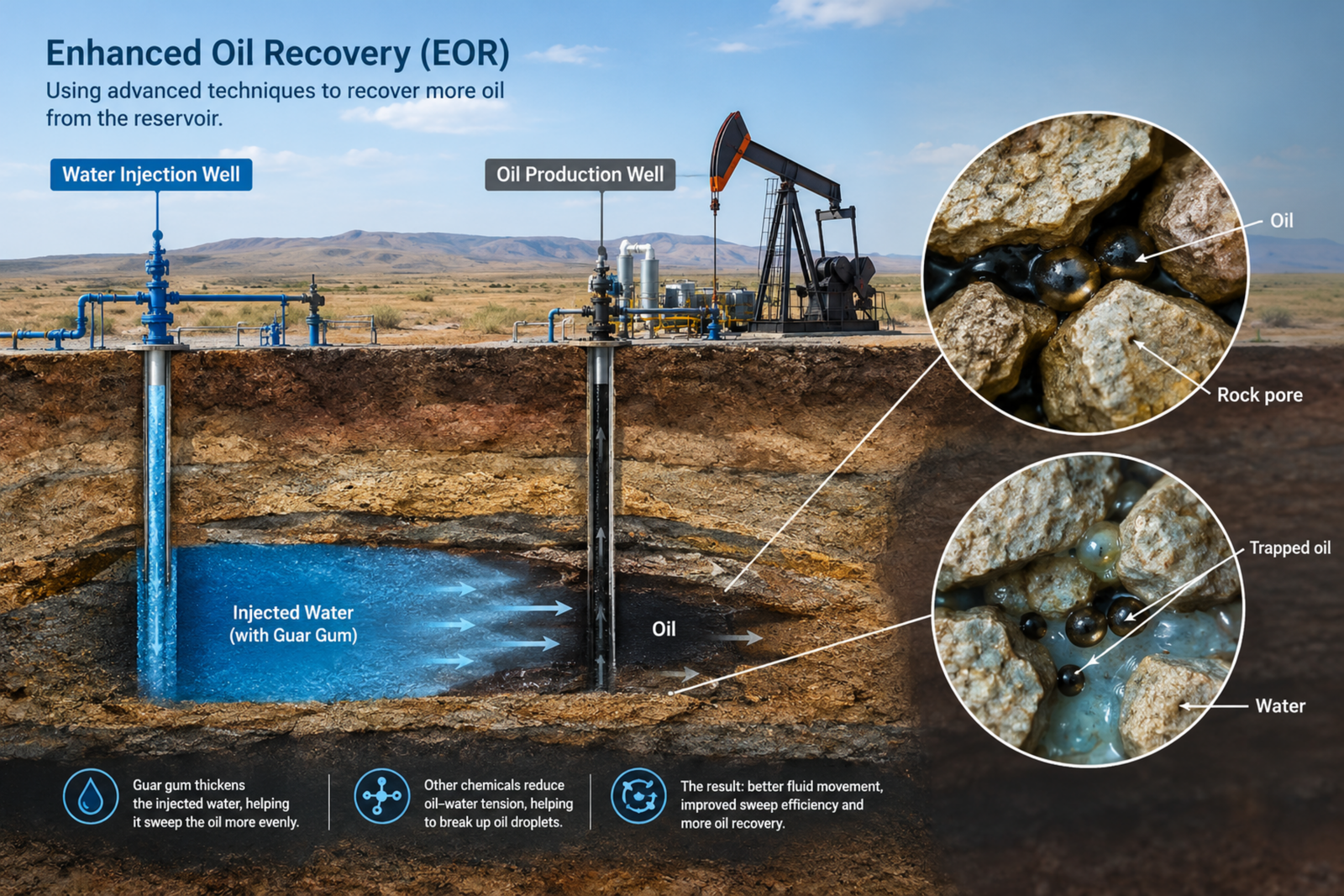
EOR techniques change the reservoir environment using three main approaches: 1. Chemical Flooding: Injected chemicals (like polymers, surfactants, or alkaline solutions) alter the oil’s properties. For example, adding guar gum thickens the injected water so it sweeps the oil out more evenly instead of just rushing past it. Other chemicals act like dish soap to break up oil droplets.
2. Thermal Recovery: Steam or hot water is injected to heat up heavy, thick oil. The heat lowers the oil’s viscosity (making it thinner and less sticky) so it can flow freely to the production well.
3. Gas Injection: Gases like carbon dioxide (CO₂), natural gas, or nitrogen are pumped into the reservoir. These gases dissolve into the oil, expanding it and thinning it out so it moves easily through the rock.
What Is Guar Gum and Why Is It Used in the Oil and Gas Industry?
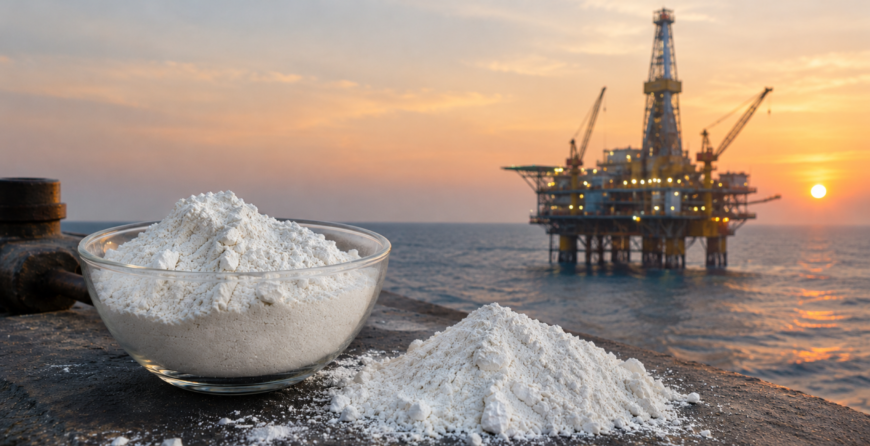
Guar gum is a natural, water-soluble polymer obtained from the endosperm of guar seeds. The guar plant, scientifically known as Cyamopsis tetragonoloba, is widely cultivated in India and other countries.
Guar gum powder is known for its ability to absorb water and form a thick solution. Even at relatively low concentrations, it can increase the viscosity of water.
Viscosity refers to a fluid’s resistance to flow. For example, water flows more easily than a thick guar gum solution.
This property makes guar gum useful in several industrial applications, including selected oilfield operations.
In the oil and gas industry, guar gum and its derivatives are widely associated with drilling fluids and hydraulic fracturing fluids. Their use in EOR is also being investigated, particularly in polymer flooding applications.
The potential value of Guar Gum in EOR comes from its ability to change how an injected fluid behaves inside a reservoir.
Instead of allowing injected water to move too easily through certain pathways, a suitably formulated polymer solution may help improve the distribution of the injected fluid.
However, guar gum is not suitable for every reservoir or every oil recovery technique. Its performance must be evaluated under the conditions in which it will be used.
How Does Guar Gum Work in Enhanced Oil Recovery?
To understand Guar Gum in EOR, it helps to look at how oil moves through an underground reservoir.
Imagine a reservoir containing oil trapped inside small spaces between rock particles. When water is injected into the reservoir, it pushes the oil towards a production well.
However, water does not always spread evenly through the reservoir. It may travel more easily through certain paths while leaving oil behind in other areas.
Polymer flooding aims to improve this process by increasing the viscosity of the injected water.
Here is how guar gum may contribute.
1. Increasing Fluid Viscosity
Guar gum can increase the viscosity of water-based fluids.
When used in a suitable polymer flooding formulation, this increase in viscosity can help reduce the mobility of the injected water. The objective is to improve the balance between the movement of water and oil through the reservoir.
A properly designed polymer solution may therefore help the injected fluid contact a larger portion of the oil-bearing formation.
2. Improving Sweep Efficiency
Sweep efficiency describes how effectively an injected fluid moves through the oil-bearing areas of a reservoir.
If injected water follows only a few easy pathways, some oil may remain untouched.
Polymer flooding can help improve sweep efficiency by changing the flow behaviour of the injected fluid. Depending on the reservoir, this may allow the fluid to contact areas that would otherwise receive less water.
The potential role of Guar Gum in EOR lies in helping achieve this effect through viscosity control.
The actual improvement depends on factors such as reservoir permeability, polymer concentration, injection pressure, and fluid compatibility.
3. Supporting Additional Oil Recovery
The main objective of EOR is to recover oil that remains after conventional production methods.
When polymer flooding improves the movement of injected water through a reservoir, it may help displace additional oil towards production wells.
Laboratory studies have investigated guar gum solutions for this purpose. However, results from laboratory experiments cannot automatically be applied to every oil field.
Field performance depends on the reservoir’s characteristics, the formulation used, and the operating conditions.
For this reason, guar gum should be evaluated through appropriate laboratory testing and reservoir-specific studies before being selected for an EOR project.
Guar Gum in Oil Drilling vs. Enhanced Oil Recovery
Although the terms are sometimes used together, oil drilling and enhanced oil recovery techniques are different operations.
Understanding this difference is important when evaluating guar gum for industrial applications.
During drilling, drilling fluids help carry rock cuttings towards the surface, cool and lubricate drilling equipment, and support wellbore stability as part of the overall fluid system.
The properties required from a drilling fluid depend on the well design, formation, and drilling conditions.
Guar gum or its derivatives may be used in selected fluid formulations, depending on the application.
Guar gum in hydraulic fracturing:
Hydraulic fracturing involves pumping fluid into a rock formation at sufficient pressure to create or extend fractures. These fractures provide pathways through which oil or gas can flow.
Guar gum and modified guar products can act as thickening agents in certain fracturing fluids. The increased viscosity can help transport proppant, which consists of particles used to keep fractures open.
Guar Gum in Oil Recovery:
Enhanced oil recovery focuses on improving the amount of oil extracted from an existing reservoir.
In polymer flooding, guar gum is investigated for its ability to increase the viscosity of injected water and influence how the fluid moves through the reservoir.
Although these applications share some underlying fluid properties, they have different purposes and performance requirements.
Therefore, guar gum powder for oil drilling should not automatically be considered suitable for EOR. The appropriate grade must be selected according to the intended application.
Key Benefits of Guar Gum in EOR:
The potential benefits of Guar Gum in EOR are mainly linked to its thickening properties and its origin as a natural polymer.
Let’s look at some important considerations. 1. Effective Thickening Properties:
Guar gum can produce high-viscosity solutions at relatively low concentrations, depending on the grade and preparation conditions.
This property makes it a material of interest for applications that require viscosity control.
In EOR formulations, the required viscosity must be determined according to the reservoir and injection conditions. 2. Natural Polymer Origin:
Guar gum is plant-derived and can be obtained from a renewable agricultural resource.
This makes it an interesting material for researchers exploring natural polymers for industrial applications.
However, natural origin alone does not establish that an EOR formulation is environmentally preferable. The complete formulation, processing requirements, degradation behaviour, and disposal conditions must also be considered. 3. Water Hydration Properties:
Guar gum hydrates in water and forms a viscous solution.
The quality of the resulting solution depends on several factors, including the powder’s particle size, concentration, water chemistry, mixing conditions, and hydration time.
Good guar gum hydration is important when preparing a polymer solution for laboratory evaluation or an industrial process. 4. Potential for Improving Fluid Movement:
Polymer flooding aims to improve the movement of injected water through an oil-bearing formation.
By increasing water viscosity, a suitable guar-based formulation may help improve the distribution of the injected fluid and support additional oil displacement.
The effectiveness of this approach must be established through testing rather than assumed from viscosity alone. 5. Opportunities for Formulation Development:
Guar gum can be evaluated alongside other polymers and additives to develop fluids with specific properties.
Researchers may investigate concentration, viscosity, temperature stability, salt tolerance, and compatibility with reservoir fluids.
These factors help determine whether a guar-based formulation is appropriate for a particular EOR application.
Guar Gum Powder for Enhanced Oil Recovery: What Affects Its Performance?
Selecting guar gum for an oilfield application involves more than choosing a powder with a high viscosity value.
For Guar Gum in EOR, several product and operating factors can influence the final results.
1. Viscosity
Viscosity is one of the most important properties to evaluate.
A suitable viscosity helps determine how the polymer solution will flow under the intended operating conditions.
However, higher viscosity is not always better. Excessive viscosity may increase injection pressure requirements and make it difficult to pump the fluid through the reservoir.
The target viscosity should therefore be based on the formulation and reservoir requirements.
2. Particle Size and Mesh
The guar gum mesh size influences how quickly it disperses and hydrates under specific preparation conditions.
Finer particles may hydrate more quickly in some systems, but the final performance also depends on the powder’s characteristics, mixing method, and water quality.
Oilfield operators should evaluate the grade that best meets their fluid preparation and processing requirements.
3. Hydration Time
Guar gum needs sufficient time and appropriate mixing conditions to hydrate properly.
Poor dispersion can lead to lumps, uneven hydration, and inconsistent viscosity.
Proper mixing procedures are important for preparing a uniform solution and obtaining reliable test results.
4. Temperature
Reservoir temperatures can affect polymer viscosity and stability.
A formulation that performs well at room temperature may behave differently under downhole conditions.
For this reason, testing should consider the temperature range expected during the intended operation.
5. Water Salinity
Water used in oil recovery may contain dissolved salts.
Salt concentration and the presence of specific ions can influence polymer behaviour, viscosity, and stability.
The compatibility of guar gum with the actual injection water or reservoir brine should be evaluated before selecting a formulation.
6. Microbial Degradation
Like other natural polymers, guar gum can be susceptible to microbial degradation.
This may affect its viscosity and stability over time.
Appropriate formulation design, storage conditions, and degradation-control strategies may be necessary, subject to compatibility and environmental requirements.
These considerations demonstrate why Guar Gum in EOR requires application-specific evaluation rather than relying on a single laboratory viscosity result.
Guar Gum Powder in Oil Drilling: How Is It Different from EOR Applications?
The phrase guar gum powder in oil drilling is often used broadly to describe guar gum applications in the petroleum industry.
However, different operations require different fluid properties.
In drilling fluids, the formulation may need to carry cuttings, support wellbore conditions, and maintain suitable flow characteristics.
In hydraulic fracturing, the fluid may need sufficient viscosity to transport proppant into fractures.
In enhanced oil recovery, the objective of polymer flooding is to influence the mobility of injected water and improve oil displacement.
These differences affect how the material is selected and tested.
When choosing guar gum powder for oilfield applications, companies should consider the intended use, required viscosity, hydration behaviour, particle size, temperature conditions, and compatibility with other formulation ingredients.
A grade developed for one application may not meet the requirements of another.
How to Choose the Right Guar Gum Supplier for Oilfield Applications
Product quality is an important consideration when sourcing guar gum powder for industrial use.
Oilfield companies need materials that meet their specified requirements and perform consistently during preparation and application.
Here are some factors to consider when evaluating a supplier. 1. Consistent quality: The product should meet agreed specifications from batch to batch. 2. Viscosity testing: Test results should be generated using a defined method, including the specified concentration, temperature, hydration time, and measurement conditions. 3. Particle size: The powder should meet the agreed mesh or particle-size requirements. 4. Moisture and purity: These properties should be checked against the product specification and intended application. 5. Documentation: Suppliers should be able to provide relevant technical data sheets, certificates of analysis, and other agreed quality documents. 6. Packaging and storage: Packaging should protect the powder from moisture and contamination during handling, transportation, and storage.
For buyers looking for Guar Gum Powder for Enhanced Oil Recovery, it is also important to communicate the intended application clearly. This allows the supplier to discuss the relevant product specifications rather than recommending a grade based on a general industrial description.
At Durga Enterprises, guar gum powder is part of our broader product portfolio serving industrial and international markets. Buyers evaluating guar gum for oilfield applications should share their required specifications so that product suitability can be assessed against their technical needs.
The Future of Guar Gum in Enhanced Oil Recovery
The oil and gas industry continues to explore materials that can improve production efficiency while meeting technical and operational requirements.
Natural polymers are receiving research attention because of their thickening properties and potential applications in fluid systems.
Guar gum is one such material. Its ability to increase water viscosity makes it relevant to investigations into polymer flooding and other specialised oilfield fluid formulations. It has already been incorporated in several polymer flooding projects in india.
However, important challenges remain. Temperature, salinity, microbial degradation, injection pressure, and compatibility with reservoir conditions can all affect performance.
Future research may help improve formulation design and identify the reservoir conditions under which guar-based polymers can offer practical benefits.
For oilfield operators, the most important step is to evaluate the complete formulation under realistic operating conditions before moving from laboratory testing to field application.
Conclusion:
Enhanced Oil Recovery plays an important role in extracting additional oil from existing reservoirs. As conventional recovery becomes less effective, suitable chemical and polymer-based techniques can help improve fluid movement and oil displacement.
Guar Gum in EOR is a promising area of research because guar gum can increase the viscosity of water-based solutions. In suitable polymer-flooding formulations, this property may help improve sweep efficiency and support additional oil recovery.
At the same time, guar gum is not a universal solution for every reservoir. Its performance depends on viscosity requirements, temperature, salinity, microbial stability, and other operating conditions.
For oilfield buyers, engineers, and chemical suppliers, understanding these factors is essential when evaluating guar gum powder for enhanced oil recovery.
Choosing the right grade, conducting appropriate laboratory tests, and confirming compatibility with the intended application can help determine whether guar gum is suitable for a particular oilfield operation.
As research continues, guar gum may offer further opportunities in specialised oil recovery formulations, provided its benefits and limitations are carefully evaluated.
FAQs:
1. What is guar gum in EOR?
The main objective of EOR is to recover oil that remains after conventional production methods. It increases viscosity and helps move remaining oil towards production wells.
2. How does guar gum help in enhanced oil recovery?
Guar gum thickens water-based fluids, which may help them move more effectively through an oil reservoir and push trapped oil towards production wells.
3. Can guar gum help recover more oil?
It may help recover additional oil when used in a suitable polymer-flooding formulation. However, its effectiveness depends on the reservoir and operating conditions.
4. Does the quality of guar gum powder affect its performance?
Yes, factors such as viscosity, particle size, and hydration behaviour can affect how guar gum performs in an oilfield fluid formulation, that’s why reaching out to reputed guar gum supplier and using high-quality guar gum is suggested.
5. Can guar gum be used in every oil reservoir?
No, every reservoir is different. Temperature, water salinity, rock properties, and other conditions must be considered before selecting guar gum for an EOR application.
6. What is the difference between guar gum in oil drilling and EOR?
Oil drilling focuses on creating wells, while enhanced oil recovery aims to extract more oil from existing reservoirs. Guar gum can serve different purposes in these applications.
7. How much % of guar gum is used in EOR operations?
Guar gum is highly effective; concentrations of approximately 0.1% to 2% have been investigated in laboratory studies for enhanced oil recovery.
8. What are the main benefits of Guar Gum in EOR?
Guar Gum in EOR can thicken the injected water, helping it reach more areas of the oil reservoir and push out more trapped oil.
9. Is guar gum better than synthetic polymers for EOR?
Guar Gum can be more effective in EOR than other synthetic polymers because it thickens the injected water so it sweeps the oil out more evenly instead of just rushing past it. Other chemicals can act like dish soap to break up oil droplets.
10. Is guar gum used in commercial EOR operations?
Guar gum is widely used in hydraulic fracturing, and its further use in EOR depends on the oil reservoir and the specific applications.