Last Updated on September 21, 2026 by admin
Textile manufacturing is not only about producing fabric. The final look, feel, strength, smoothness, and finish of a fabric can depend on several processing and finishing steps. Different ingredients are used during these processes to control the behaviour of formulations and improve the final fabric properties. One such useful plant-based ingredient is textile grade guar gum.
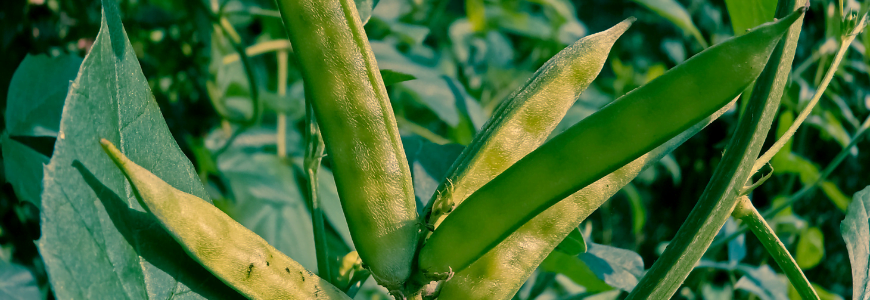
Guar gum is obtained from the seeds of the guar plant, Cyamopsis tetragonoloba. After processing, it becomes a fine powder with strong water-binding and thickening properties. When mixed with water, guar gum hydrates and increases the viscosity of the solution. This makes it useful in several applications where controlled flow, binding, thickening, and film formation are required.
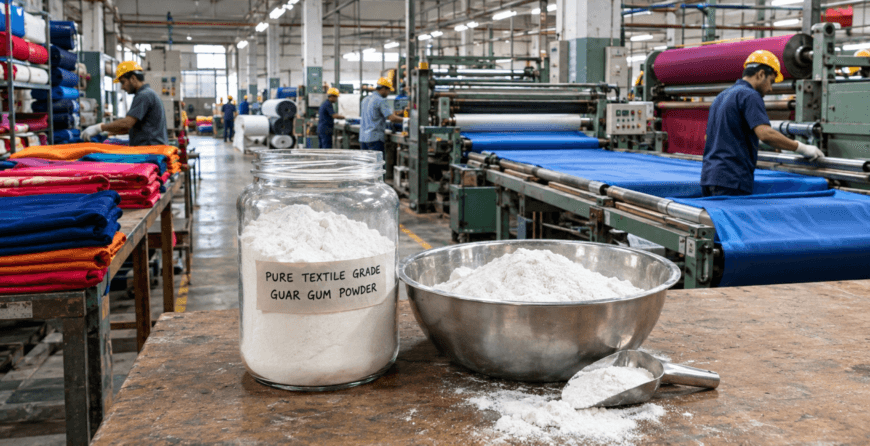
In textile applications, guar gum for textiles can be used in areas such as textile printing, fabric finishing, fabric stiffening, textile coating, and selected laundry and textile care formulations.
The growing interest in plant-based and functional ingredients has also increased attention toward guar gum textile grade as a practical ingredient for textile processing.
What is Textile Grade Guar Gum?
Textile grade guar gum is a processed guar gum powder selected for textile-related applications where thickening, binding, viscosity control, or fabric finishing properties are required.
Guar gum is a natural polysaccharide mainly made up of galactomannan. In simple words, it is a plant-derived material that can absorb water and make a liquid thicker.
When added to water under suitable mixing conditions, guar gum hydrates and creates a viscous solution. This thick solution can help control how a textile formulation moves across or interacts with fabric.
Depending on the application, guar gum may be used as:
- A textile thickener
- A textile printing thickener
- A fabric stiffening agent
- A textile finishing agent
- A binder
- A viscosity-control ingredient
- A film-forming aid
- A processing aid
Why Is Guar Gum Used in Textiles?
The main reason guar gum used in textile applications is its ability to increase viscosity and hold water.
In many textile processes, a liquid formulation needs to remain controlled during application. If it is too thin, it may spread too quickly or penetrate the fabric unevenly. A suitable thickener can help provide better control.
This is where textile grade guar gum can be useful.
Some important properties include:
1. Water-binding ability: Guar gum can absorb and hold water, helping increase the thickness of aqueous formulations.
2. Thickening ability: Even at controlled concentrations, guar gum can provide significant viscosity.
3. Binding properties: Guar gum can help bind ingredients together in suitable textile formulations.
4. Film-forming behaviour: After application and drying, guar gum can contribute to a film or coating effect depending on the formulation.
5. Plant-based origin: Guar gum comes from guar seeds, making it a plant-derived ingredient.
6. Flexible application: Different grades can be selected based on viscosity, mesh, and processing requirements.
Guar gum as a Textile Thickener:
One of the most important applications of guar gum is as a textile thickener.
A thickener is used to increase the viscosity of a liquid or paste. In textile processing, viscosity control can be important for printing, coating, and finishing.
For example, a printing paste that is too thin may spread beyond the intended design. A suitable thickening system can help keep the paste more controlled during application.
This is why guar gum for textile printing is considered in different textile printing formulations.
The performance of the thickener depends on factors such as:
1. Guar gum grade
2. Viscosity
3. Mesh size
4. Concentration
5. Water quality
6. Mixing method
7. Temperature
8. Printing technique
9. Fabric type
The right combination can help create a printing paste with suitable flow and application properties.
Guar Gum Powder for Textile Printing:
Guar gum powder for textile printing can be used as a thickening and binding ingredient in suitable printing paste formulations.
Textile printing requires a controlled paste consistency. The paste needs to move through the printing process while remaining sufficiently controlled on the fabric.
Textile grade guar gum can help increase viscosity and reduce excessive spreading of the liquid system.
It may support:
1. Controlled printing paste flow
2. Better paste consistency
3. Improved application control
4. Reduced unwanted spreading
5. Better handling during printing
6. More uniform application
7. Suitable print definition in selected formulations
The exact performance depends on the printing process and complete formulation.
Different textile printing methods may require different paste characteristics. Screen printing, block printing, roller printing, and other methods can have different requirements.
Therefore, there is no single guar gum concentration that should be considered suitable for every textile printing application.
Guar Gum in Fabric Finishing:
Guar gum in fabric finishing can be considered where a plant-based thickener or binder is required.
During fabric finishing, the formulation needs to be applied evenly across the fabric. A suitable viscosity can help the finishing solution remain more controlled during application.
Once the treatment is applied, the fabric may go through drying, curing, washing, or other processing steps depending on the finishing system.
Manufacturers should therefore evaluate the complete process rather than looking at guar gum as a standalone finishing solution.
How Does Guar Gum Control Viscosity?
Viscosity simply refers to how easily a liquid flows.
Water flows very easily and therefore has low viscosity. A thick paste flows much more slowly and has higher viscosity.
When guar gum hydrates in water, it increases the thickness of the liquid. This allows manufacturers to adjust the flow behaviour of their textile formulation.
This property is important for guar gum viscosity for textile applications because different textile processes need different levels of flow control.
For example:
1. A printing paste may require controlled flow.
2. A coating formulation may need to remain on the surface.
3. A finishing solution may need consistent application.
4. A textile treatment may need a specific thickness for proper handling.
The correct viscosity grade should therefore be selected according to the application.
Guar Gum Hydration in Textile Applications:
Hydration is one of the most important characteristics of guar gum.
When guar gum powder comes into contact with water, the particles begin to absorb water and swell. With proper mixing, the solution becomes increasingly viscous.
The guar gum hydration behaviour can be affected by:
1. Water temperature
2. Mixing speed
3. Mixing time
4. Powder particle size
5. Concentration
6. Water quality
7. Other ingredients
For textile manufacturers, consistent hydration can help with repeatable formulation preparation.
This is especially important in production environments where the same textile formulation needs to be prepared regularly.
Guar Gum For Fabric Care Products:
Modern fabric care products can contain multiple ingredients that perform different functions.
A thickener may be required to provide the desired product consistency, while other ingredients may provide cleaning, conditioning, fragrance, or finishing effects.
In suitable systems, guar gum for fabric care can provide viscosity and binding support.
However, the correct grade should be selected based on the final product rather than simply choosing a generic guar gum powder.
Textile Grade Guar Gum and Fabric Feel:
Fabric feel is one of the most noticeable results of textile finishing.
Consumers may describe fabric as soft, smooth, crisp, firm, silky, heavy, or lightweight. These characteristics can be influenced by the fibre, fabric construction, washing process, and finishing treatment.
A suitable finishing formulation can help create the desired fabric feel.
Textile grade guar gum can contribute to this process through its thickening, binding, and film-forming properties.
However, the amount used is important.
A low concentration may provide limited effect, while a higher concentration may produce excessive viscosity or an unwanted fabric feel.
Testing is therefore an important part of developing a textile finishing formulation.
Guar Gum for Textile Coating:
Textile coating involves applying a material to the surface of a fabric to provide specific properties.
Depending on the application, coating formulations may need controlled viscosity and good spreading behaviour.
Because guar gum can increase viscosity, guar gum for textile coating may be considered in suitable water-based systems.
The final result depends on the coating formulation, fabric surface, application method, drying process, and concentration of guar gum.
This makes laboratory testing important before moving to large-scale textile production.
Benefits of Guar Gum in Textile Applications:
When the correct grade is selected, guar gum can offer several useful properties for textile applications.
Key benefits include:
- Plant-based thickening ingredient
- Good water-binding capacity
- Effective viscosity control
- Binding support
- Film-forming properties
- Useful for printing paste formulations
- Suitable for selected fabric finishing systems
- Available in different viscosity grades
- Available in different mesh sizes
- Can be used at controlled concentrations
- Helps improve formulation consistency
- Useful in selected textile care formulations
Choosing the Right Guar Gum for Textile Applications:
Choosing the right textile grade guar gum is important because textile processes can have very different requirements.
Before selecting a guar gum grade, manufacturers should consider:
1. Viscosity: The viscosity should match the requirements of the printing, finishing, coating, or textile care formulation.
2. Mesh size: Mesh size affects powder handling, dispersion, and hydration behaviour.
3. Hydration: The guar gum should provide suitable hydration under the intended processing conditions.
4. Purity: Consistent quality is important for repeatable textile processing.
5. Application: The grade should be selected based on whether it is intended for textile printing, fabric finishing, coating, stiffening, or another application.
6. Compatibility: The guar gum should be tested with the other ingredients in the formulation.
Why Guar Gum Quality Matters in Textile Processing:
Consistent raw material quality is important for textile manufacturers.
If the viscosity or hydration behaviour changes from one batch to another, the final printing or finishing result can also change.
For this reason, buyers looking for a guar gum supplier for textile industry applications should review technical specifications and batch consistency.
Useful information may include:
- Viscosity specification
- Mesh size
- Moisture
- Purity
- Appearance
- Batch information
- Certificate of Analysis
- Packaging details
- Application guidance
A supplier should be able to provide clear product information for the intended application.
Guar Gum Packaging and Storage:
Proper packaging and storage are also important for maintaining guar gum quality.
Guar gum powder should generally be stored in a dry, clean environment and protected from direct moisture.
The package should remain properly closed when the product is not being used.
Good storage practices help reduce the risk of:
1. Moisture absorption
2. Powder clumping
3. Contamination
4. Changes in powder handling
5. Reduced processing consistency
For industrial textile users, proper storage is especially important when guar gum is purchased in bulk.
How to Use Guar Gum in Textile Fomulations?
There is no universal dosage for every textile application.
The required amount depends on the type of formulation and the desired viscosity or finishing effect. A general development process can include:
1. Select the right grade of textile guar gum for specific fabric.
2. Measure clean water under standard workshop conditions.
3. Pour the guar gum slowly into the water while stirring constantly to prevent lumps.
4. Let the mixture sit until the gum completely dissolves and thickens.
5. Stir in your remaining formulation chemicals or dyes.
6. Apply a small amount of the final mixture onto a sample piece of fabric.
7. Dry the sample to check if the color, thickness, and feel are correct.
Add more gum to thicken the mixture, or more water to thin it, before making a large batch.Small-scale trials can help manufacturers identify the most suitable concentration before full-scale production.
Textile Grade Guar Gum for Different Fabrics:
Different fibres have different surface characteristics and absorbency.
Guar gum may be evaluated for applications involving:
- Cotton fabric
- Polyester fabric
- Viscose fabric
- Rayon fabric
- Blended fabrics
- Other textile materials
The formulation may need to be adjusted according to the fabric.
Testing can help evaluate:
- Fabric hand
- Stiffness
- Smoothness
- Surface appearance
- Application uniformity
- Wash behaviour
- Drying behaviour
- Overall finishing performance
Why Manufacturers Use Guar Gum in Textile Printing:
Textile printing requires careful control of printing paste.
The paste should have enough body to remain controlled while still being suitable for the selected printing method.
This is one of the main reasons guar gum powder for textile printing can be considered as a thickening ingredient.
Its ability to increase viscosity can help manufacturers develop printing pastes with suitable flow characteristics.
However, the final printing quality depends on the complete system, including dyes or pigments, binders, fabric type, printing method, drying, and other processing conditions.
Looking for a Reliable Textile Grade Guar Gum Supplier:
Choosing the right guar gum supplier can make a real difference when consistency, viscosity, and reliable textile processing are important.
Durga Enterprises is a supplier of guar gum products for industrial applications, including textile-related uses. If you are looking for textile grade guar gum, guar gum for textile printing, guar gum for fabric finishing, or guar gum powder for textile applications, the right product specification should be matched to your specific process.
Conclusion:
Guar gum has several properties that make it useful for textile-related applications. Its ability to absorb water, increase viscosity, bind ingredients, and provide film-forming support makes it suitable for consideration in textile printing, fabric finishing, stiffening, coating, and selected textile care formulations.
Textile grade guar gum can act as a useful thickening and processing aid when the right grade is selected for the right application.
For textile printing, guar gum for textiles can help control the consistency and flow of printing paste. For fabric finishing, it can provide thickening and binding support while contributing to the desired fabric feel. In selected laundry and textile care products, it can help control product viscosity and formulation consistency.
The most important point is that guar gum performance depends on the grade, concentration, fabric, application method, and complete formulation.
Manufacturers looking for a guar gum supplier for textile industry applications should therefore consider technical specifications, viscosity, mesh size, hydration behaviour, batch consistency, and application requirements before selecting a product.
With proper selection and formulation testing, guar gum can be a practical plant-based ingredient for modern textile processing, printing, fabric finishing, and textile care.
FAQs:
1. What is textile grade guar gum?
Textile grade guar gum is a processed guar gum powder used in suitable textile formulations as a thickener, binder, stiffening aid, or finishing ingredient.
2. What is guar gum used for in textiles?
Guar gum used in textile applications can help with viscosity control, printing paste preparation, fabric finishing, binding, coating, and selected textile care formulations.
3. Is guar gum used in textile printing?
Yes. Guar gum for textile printing can be used as a thickening ingredient in suitable printing paste formulations to help control viscosity and flow.
4. What is guar gum powder for textile printing?
Guar gum powder for textile printing is a fine guar gum material used in suitable printing systems where increased viscosity and controlled paste flow are required.
5. Can guar gum be used as a textile stiffener?
Yes. In suitable formulations, guar gum as a textile stiffener can contribute to fabric body and stiffness. The final result depends on concentration, fabric type, and the complete finishing formulation.
6. Is guar gum a textile finishing agent?
Guar gum can be used as a thickening, binding, and finishing aid in suitable textile finishing formulations. Its suitability depends on the required fabric properties and formulation.
7. What are the benefits of guar gum in textile printing?
Potential benefits include viscosity control, improved paste consistency, controlled flow, binding support, and reduced unwanted spreading in suitable printing formulations.
8. Can guar gum be used for fabric finishing?
Yes. Guar gum for fabric finishing can be evaluated in formulations where thickening, binding, or film-forming support is required.
9. Can guar gum be used in laundry care products?
It can be considered in selected laundry care formulations where thickening, binding, or controlled viscosity is required. The final formulation should be tested for compatibility and performance.
10. What affects guar gum hydration?
Water temperature, mixing speed, mixing time, particle size, concentration, water quality, and other formulation ingredients can affect guar gum hydration.
11. How can I test guar gum for textile use?
Start with a small laboratory trial. Prepare the formulation, check viscosity and hydration, apply it to a fabric sample, and evaluate the final feel, appearance, stiffness, and other required properties.
12. How do I choose guar gum for textile applications?
Consider viscosity, mesh size, hydration behaviour, purity, application method, fabric type, and compatibility with other formulation ingredients.